




This article compares inductive and capacitive proximity sensors for industrial automation, explaining their working principles, applications, and key differences to guide engineers in selecting the optimal non-contact sensing solution for system reliability and efficiency.
In the field of rapid development of industrial automation, the reasonable selection of sensing technology directly determines the operation efficiency and reliability of the system. A typical problem faced by engineers and technicians in reality is: how to choose between inductive vs capacitive proximity sensors. Although both sensors achieve object detection in a non-contact manner, they operate based on very different physical principles, and the applicable scenarios are also different.
This article will analyze the working principle, application scenarios, advantages and disadvantages of inductive and capacitive proximity sensors in detail, so as to ensure that you can make the best decisions for specific applications.
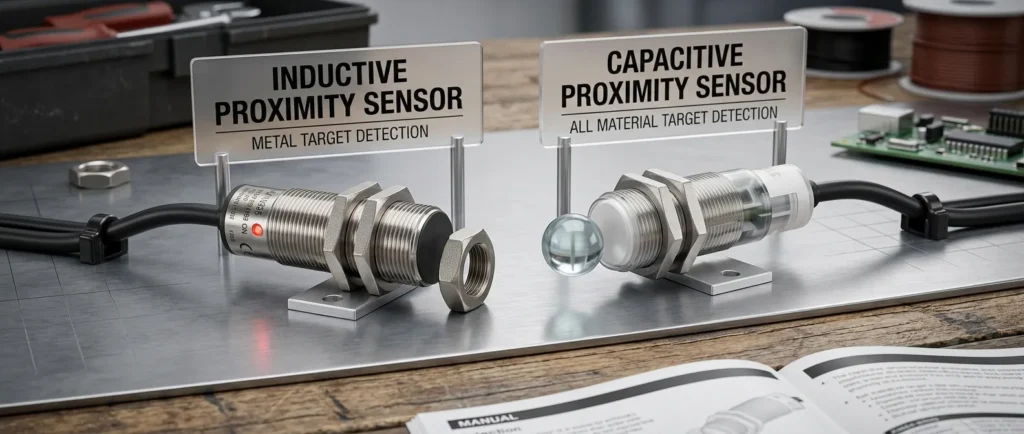
What are Proximity Sensors?
Proximity sensor is used to detect the existence or distance of an object in the non-contact situation. The proximity sensor can be detected without contacting the measured object like a limit switch. They have longer service life, higher reliability and better wear resistance.
Proximity sensors are used in all aspects from smart product production lines to food packaging plants. However, the material of the detection target also affects which type of sensor is required.
Inductive Proximity Sensors
The Sensing Technology of Inductive Proximity Switches
The principle of inductive proximity sensor comes from electromagnetic induction. An oscillating electromagnetic field is generated around the induction surface. When the conductive target (especially the metal) enters the magnetic field, Eddy Currents are generated inside the target object. These eddy currents consume energy from the oscillator so that the oscillation amplitude is reduced. The internal circuit of the sensor detects the drop and triggers the output state (ON or OFF).
The inductive proximity sensor can identify ferrous metals and non-ferrous metals such as aluminum and copper. The sensing distance is usually short. According to the size of the sensor, the effective detection range is generally between 1mm and 60mm. In terms of durability, inductive proximity sensors have solid structure, which can prevent pollutants such as oil, dust, water and debris, and ensure long-term stable performance.
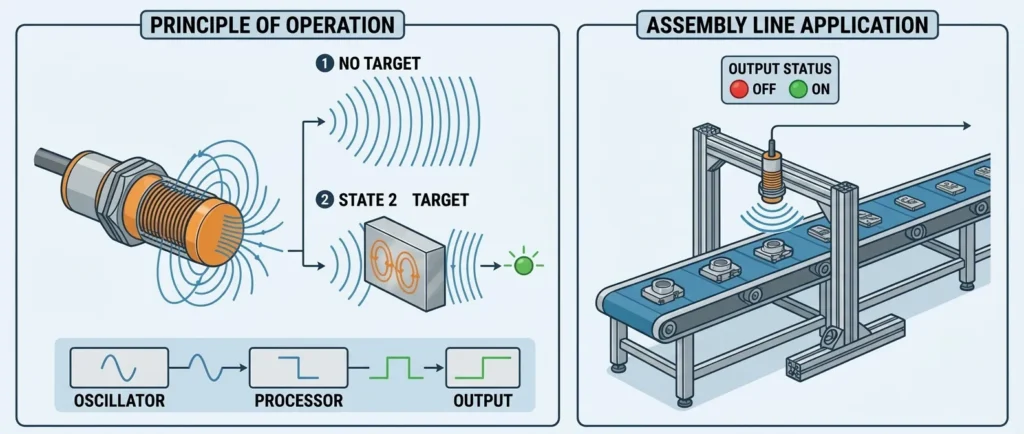
In the field of machine tool processing, they are often used to accurately detect the position of the metal arm or drill bit; in the automobile assembly production line, it can be used to verify whether the key metal parts such as the chassis are installed in place; in addition, in the application of gear speed measurement, they can also accurately calculate the number of rotations of gear teeth and realize speed monitoring.
Capacitive Proximity Sensors
How Does the Capacitive Proximity Sensor Work?
The capacitive proximity sensor generates an electrostatic field when it works. The electrode of the sensing head is equivalent to one plate of the capacitor, and the detected object is equivalent to another plate. When the object is close to the sensing surface of the sensor, it will change the dielectric constant of the dielectric between the two, resulting in the change of the equivalent capacitance value of the internal circuit of the sensor. The detection circuit continuously monitors this capacitance value. Once the capacitance increment caused by the proximity of the object exceeds the preset threshold, the oscillation circuit will be excited, and the sensor will immediately flip the output state to complete the recognition of the proximity action of the object.
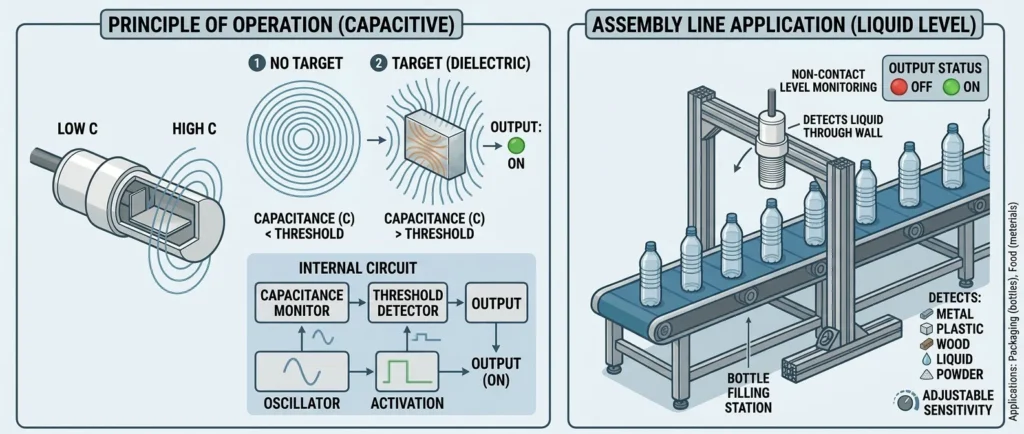
Capacitive proximity sensors can detect metal, plastic, wood, liquid, powder and other non-metallic objects. Its sensitivity is usually adjustable, so it can penetrate the non-metallic container wall to detect internal materials. Based on these characteristics, it is widely used in material detection in food processing, inspection of the existence of cartons or bottle caps in the packaging industry, and non-contact liquid level monitoring through plastic or glass mirrors.
Please refer to our article to ensure the correct wiring of the proximity sensor:
NPN vs. PNP: What’s the Difference in Industrial Proximity Sensors?
Inductive vs Capacitive Proximity Sensor
| Comparison table of inductive proximity sensors and capacitive proximity sensors | ||
|---|---|---|
| Feature | Inductive Proximity Sensors | Capacitive Proximity Sensors |
| Sensing Principle | Electromagnetic Field | Electrostatic Field |
| Target Material | Metals only (Iron, Aluminum, Copper, etc.) | Any material (Metal, Plastic, Liquid, Wood) |
| Interference | Immune to non-metal dirt, oil, and water | Sensitive to moisture, humidity, and dust buildup |
| Sensing Range | Short (< 60mm), fixed | Short to Medium, often adjustable sensitivity |
| Look-Through Ability | Cannot sense through walls | Can sense liquids/powders through non-metal walls |
| Cost | Generally lower cost | Typically more expensive |
Capacitive and Inductive Proximity Sensor: Advantages & Limitations
Inductive proximity sensor
Advantages:
- High reliability: Its working principle determines that it has inherent resistance to non-metallic interfering substances, and can work stably even under harsh conditions of oil pollution or water vapor splashing.
- High switching frequency: Designed for high speed detection scenarios, it can accurately detect fast moving metal targets with extremely short response time, which helps to improve the beat and detection accuracy of the production line.
Disadvantages:
- Limitation of application range: The natural shortcoming of inductive sensors is that they can only detect metal materials and cannot identify non-metallic targets such as plastics, glass or liquids.
- Limited installation distance: The detection distance of the inductive proximity sensor is short, which requires the sensor to be installed close to the target object, resulting in limited installation space.
Capacitive proximity sensor
Advantages:
- Broad detection materials: it can detect almost all types of materials and is suitable for application under complex working conditions.
- Through-the-wall sensing: The capacitive proximity sensor has the sensing ability to penetrate the non-metallic container, and can accurately identify the material state in the container without contact with the measured target.
Disadvantages:
- Environmental limitations: The detection results are susceptible to environmental impacts, especially in high humidity environments, and may have false detection results.
- Calibration requirements: In order to ensure the accuracy of the detection, the device needs to be calibrated by a potentiometer. This requires removing the interference of excess background materials to ensure that the sensor only responds to the target.
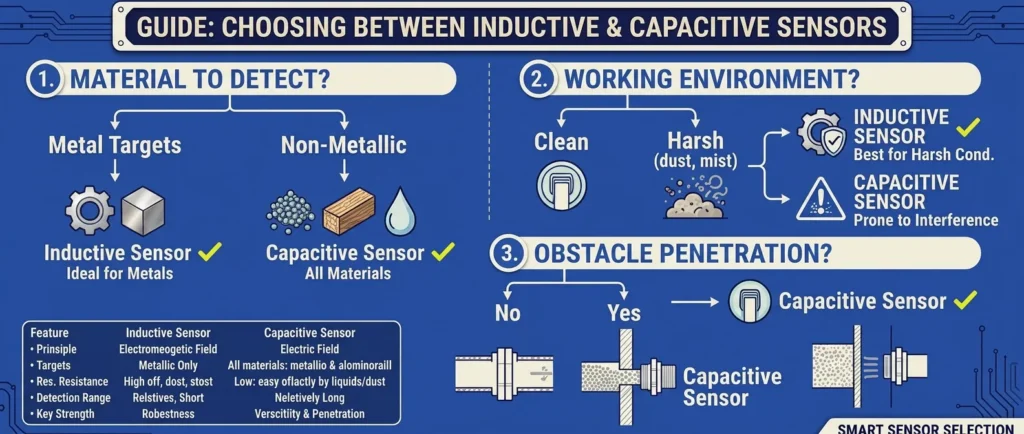
How to Choose Between Inductive and Capacitive Proximity Sensors?
- What material do you need to detect?
If the material of the detection object is metal, inductive proximity sensor is the standard solution for detecting metal materials. If the target object is a non-metallic material such as plastic, wood, or a liquid, granular material, a capacitive proximity sensor that can sense a change in dielectric constant must be selected.
- Is the working environment dirty?
In the presence of oil mist, cutting fluid or a large amount of dust and other harsh working conditions, it is recommended to give priority to the use of inductive proximity sensors. This is because the detection principle of capacitive proximity sensors are susceptible to such medium interference, which may misjudge the accumulated oil or dust as the target object, resulting in equipment malfunction or detection failure.
- Do you need to penetrate obstacles for detection?
If it is necessary to detect non-metallic materials such as water in plastic pipes or grains in hoppers) without destroying the container structure, capacitive proximity sensors are ideal. By virtue of its sensitivity to the change of dielectric constant of the medium, the sensor can effectively prevent the interference of thin-walled containers and realize the reliable detection of internal bulk materials after appropriate sensitivity calibration.
Conclusion
The core difference between inductive and capacitive proximity sensors lies in the following two points: the material of the target object and the installation environment. Similarly, it is very important to select the appropriate sensor brand, which provides a guarantee for the later stability.
For metal detection: If you need to perform high-frequency metal detection in harsh industrial environments full of oil and dust, it is recommended to choose a Gtric inductive proximity sensor. With its excellent anti-interference ability and robust shell design, Gtric can ensure continuous and accurate metal target recognition.For non-metallic and liquid level detection: When you need to detect plastic, wood, liquid, or need to penetrate the container wall for ‘perspective’ detection, the Gtric capacitive proximity sensor is the ideal choice. Its sensitive adjustable technology enables it to easily cope with complex non-metallic medium detection needs.