




Failed automation often stems from poor object detection. This guide explores common industrial proximity sensor types, their technical differences, and how top suppliers like Gtric provide reliable solutions to optimize your system.
In the design, upgrade, or maintenance of industrial automation manufacturing systems. If the running device can’t accurately perceive whether the target object exists or is missing. It will directly lead to the interruption of the automation process, and even lead to serious operational failure.
Choosing the right proximity sensor can achieve non-contact detection, besides also increase production capacity and reduce the risk of mechanical wear caused by equipment. Aiming at the object detection requirements frequently involved in the industrial environment, a common concern of technicians is: What are the specific types of proximity sensors currently mainstream in the industrial field?This article will help you understand the technical differences behind different types of proximity sensors based on your situation, and find the most suitable proximity sensor for you. And show you why top suppliers like Gtric can lead the industry and provide the most reliable detection solutions.
What Is Proximity Sensor in Industrial Automation?
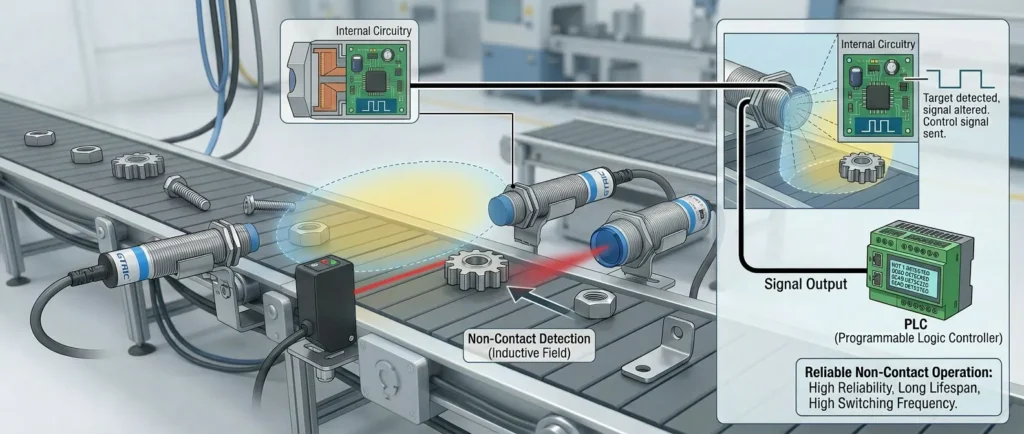
The proximity sensor detects the presence, absence or proximity of the target object without contact. A proximity sensor is different from a mechanical limit switch that physically collides with an object, but is detected by emitting electromagnetic fields, beams, or high-frequency sound waves.
When the target enters the sensing area of the sensor, it will change the return signal. At the same time, the internal circuit will instantly recognize this change and send an electrical output signal to the PLC or other industrial control system.
Due to the use of contactless operation, these industrial proximity sensors have extremely high reliability, longer life, and high switching frequency.
Why Do We Need Different Types of Proximity Sensors?
The huge difference between the manufacturing environment and the target material leads to the fact that no sensor can meet various environmental requirements. Like a proximity sensor that can detect engine cylinders on the clean and dry car assembly line, it is highly likely to stop working if it is placed in a wet and high-pressure beverage factory to detect clear glass bottles.
This is why in the selection of sensors, the following elements need to be listed in the screening list:
- Detected target material: Are the objects you want to detect black metal, non-ferrous metal, plastic, liquid or wood?
- Application environment: Does the plant often operate in an environment with high dust, moisture, cutting fluid, oil pollution or temperature fluctuations?
- Detection distance: according to the specific needs of you to detect the target, is it only 2mm away from the object, or need to cross the distance of 10 meters for induction?
- Target properties: Is the state of the target presented transparent, strongly reflective, or pore structure?
To solve these problems, different manufacturers have developed specialized detection technologies. Let’s further explore the five most common types of proximity sensors in industrial applications and their working principles.
What Are the 5 Proximity Sensor Types?
1. Inductive proximity sensor
Inductive sensors mainly detect metal objects. They are equipped with an oscillator and an electromagnetic coil, which can generate a high-frequency alternating magnetic field on the sensing surface of the sensor. When metal objects (such as steel, aluminum or brass) enter the magnetic field, a local ‘eddy current’ will be induced inside the metal target. This energy transfer suppresses the oscillator amplitude of the sensor. Once the internal solid-state circuit recognizes this amplitude drop, the output switch will be triggered immediately.
- Advantages: This sensor is designed for complex industrial environments. It is not only highly durable and can effectively resist the interference of dust, oil, water and non-metallic fouling, but also achieves extremely long service life and extremely high switching frequency due to the use of all-solid-state design without moving parts. It is an ideal choice for detecting high-speed moving metal gears, sprockets or chains.
- Disadvantages: This detection method is strictly limited to metal objects and is ineffective for plastics or liquids, and its sensing distance is relatively short, usually only between 1mm and 60mm.
It is often used in:
- Accurate position detection of metal parts in CNC milling machines.
- Counting metal cans on high-speed food packaging lines.
- As a limit switch in the robot.

2. Capacitive proximity sensor
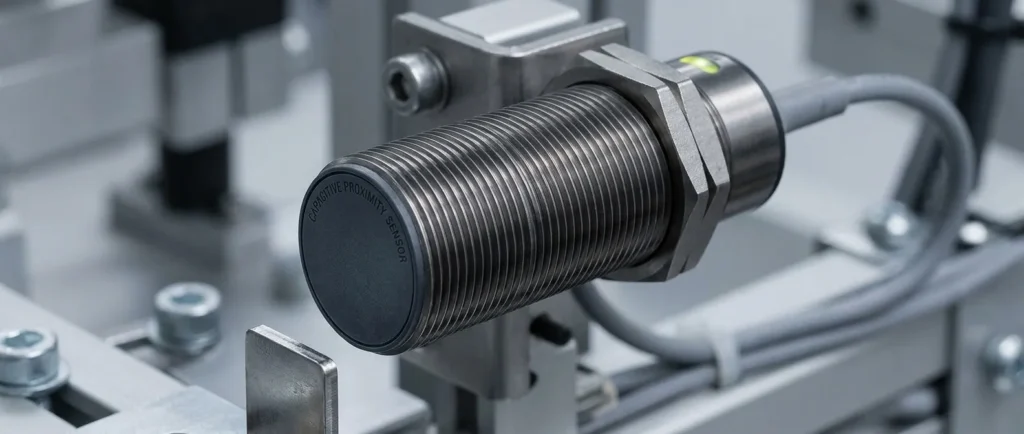
Unlike inductive models, capacitive proximity sensors are highly versatile because they can detect both metal objects and non-metal objects (including plastics, glass, wood, particles, and liquids). They produce an electrostatic field rather than a magnetic field. When any object with a dielectric constant significantly different from that of air enters this effective sound field, it will change the capacitance value of the oscillating circuit inside the sensor. This change will trigger the output of the sensor.
- Advantages: The capacitive proximity sensor has no limitation on the detection material. Whether it is solid, particle or liquid, the signal it releases can safely penetrate the wall of non-metallic containers such as plastics. This allows the operator to remotely determine the liquid level of the material in the sealed tank without opening the container or contacting the liquid, which greatly improves the safety and convenience of the detection.
- Disadvantages: It may cause false contact in a complex working environment. In addition, compared with the photoelectric proximity sensor, the effective detection distance is relatively short.
- Common applications are: Liquid level detection in opaque or transparent plastic drums in chemical plants, and detection of non-metallic objects such as cartons, paper webs, or wooden pallets in automated packaging facilities.
3. Photoelectric proximity sensor
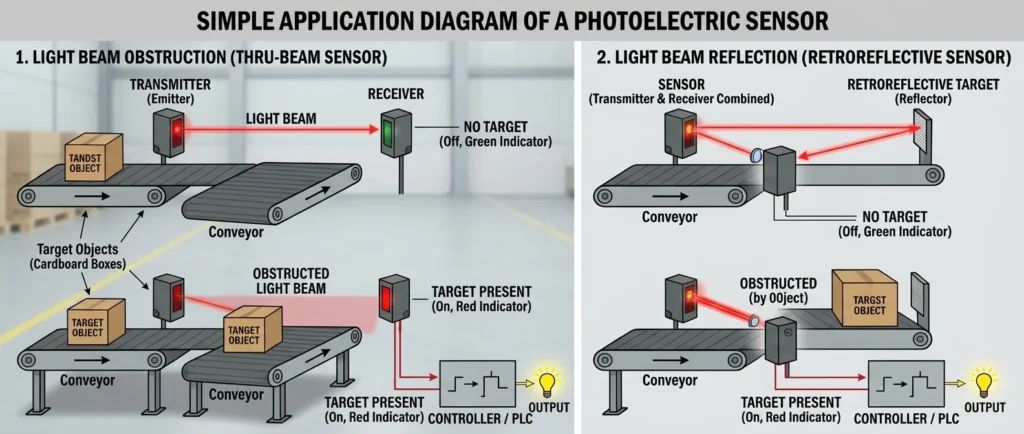
The photoelectric sensor determines whether the object exists or is far away by emitting a beam and detecting the reflection or occlusion of the beam by the target object. They are usually composed of transmitter and receiver components.
- Advantages: the detection distance is very long, the use of high-power shooting models can reach 100 meters or more; and it can detect the material, shape and size of the target without limitation.
- Disadvantages: In optical detection, the lens may be affected by dust, dirt or oil mist; at the same time, in the standard diffuse reflection sensor, if the target is transparent, extremely dark or easily reflected material, it often causes measurement errors.
- It can be seen in these scenes: vehicle detection in automatic toll stations, ensuring the correct spacing of objects on conveyor belts in large warehouses, and using invisible light curtains to protect the safety of robot working units.
4. Ultrasonic proximity sensor
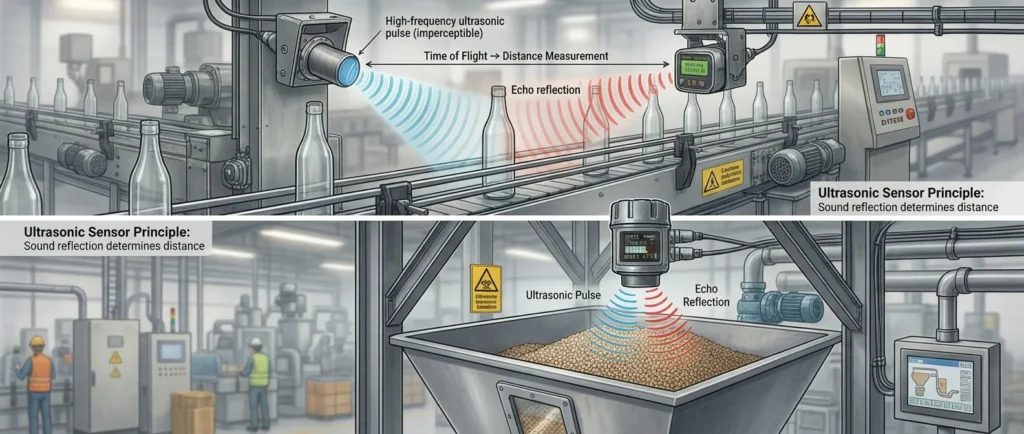
The ultrasonic sensor is the same as that of the echolocation of bats and submarine sonar: by emitting a high-frequency acoustic pulse that cannot be heard by the human ear, and measuring the exact time that the acoustic wave is reflected back from the target object. So as to achieve accurate ranging or existence detection.
- Advantages: It is not affected by object color, transparency or ambient lighting conditions, which makes it ideal for applications in the detection of transparent glass or water. It not only provides simple ON/OFF switching, but also provides highly accurate continuous distance mapping.
- Disadvantages: unable to work in vacuum. And it is sensitive to large temperature differences and strong airflow changes, which may lead to errors in the propagation time of sound waves.
- It is applied in the production of high-speed beverages to detect transparent glass bottles and monitor the accurate level of bulk solid grain hoppers.
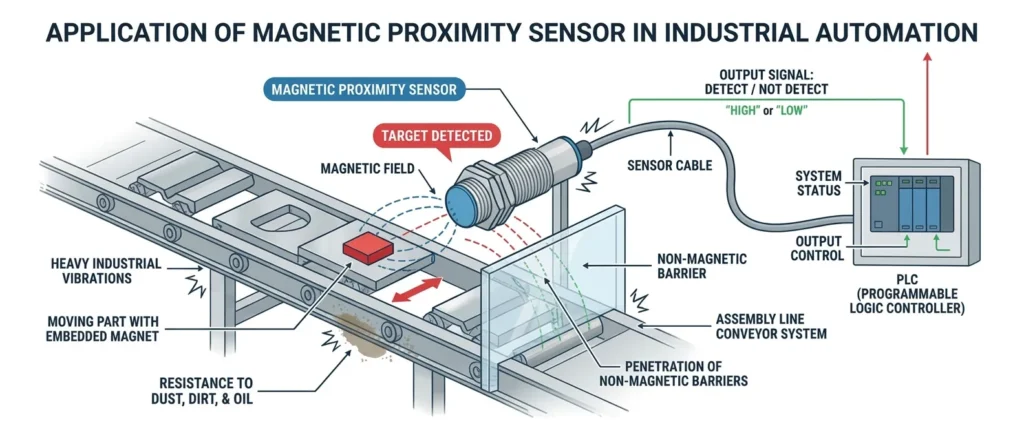
5. Magnetic proximity sensor
Magnetic proximity sensor uses magnetic field to detect the change of object position. It can detect whether the target object is close without physical contact, and is usually used for position positioning, speed measurement or limit control.
- Advantages: It is easy to penetrate a strong non-magnetic barrier to detect magnets. It has a high degree of immunity to extreme dust, dirt, oil and heavy industrial vibration.
- Disadvantages: The target object must be attached to a permanent magnet to be detected.
- It appears in: the position tracking of pneumatic and hydraulic cylinders, and the harsh environment security system for heavy access control monitoring.
In view of the importance of correct selection for industrial automation, this paper aims to simplify this decision-making process. The following is the core proximity sensor comparison table. We systematically sort out the technical characteristics and applicable scenarios of various sensors to help you quickly select:
| Proximity sensor type technical parameters reference table | ||||
|---|---|---|---|---|
| Sensor Category | Detectable Target Material | Typical Sensing Range | Environmental Tolerance | Best Standout Feature |
| Inductive | Ferrous & Non-Ferrous Metal | 1mm-60mm | Excellent (Handles dirt/oil) | Rugged industrial durability |
| Capacitive | Metal, Plastic, Wood, Liquid | 1mm-30mm | Moderate (Sensitive to water) | Sees through plastic containers |
| Photoelectric | Any Solid Object | Up to 100m+ | Low (Dust blocks lenses) | Extremely long detection range |
| Ultrasonic | Solid Objects & Liquids | 10cm-15m | Moderate (Sensitive to wind) | Ignores color and transparency |
| Magnetic | Permanent Magnets Only | Varies widely | Excellent (Highly durable) | Detects targets through solid walls |
If you would like to gain the deeper knowledge of the physical engineering principles and technological evolution behind these detection areas, we highly recommend that you consult the Proximity Sensor Principles from WIKIPEDIA
How Does Gtric Improve Industrial Sensor Technology
Getting the working principle of these sensors is only the first step; purchasing high-quality and reliable sensors is the key to ensuring automated operation. This is where industry-leading brands like Gtric come into play.
Gtric offers a broad portfolio of state-of-the-art sensing solutions designed to withstand complex industrial environments when looking for an automated detection sensor suitable for matching. Whether you need a miniature inductive sensor for a compact robotic arm or a highly sensitive capacitive sensor for chemical level monitoring, Gtric offers products that improve positioning accuracy and give it a longer service life.
Integrating the proximity sensor types provided by Gtric into your PLC system, you can effectively eliminate false triggering, reduce maintenance downtime, and significantly improve the overall throughput of the factory.
If you’re planning to upgrade your assembly line, explore Gtric’s Proximity Sensor Solution to find the right configuration for your mechanical requirements.