




Miniature inductive proximity sensors are ideal for space-constrained, high-precision applications like compact automation, cobots, and micro equipment. This guide explains their working principle, suitable applications, and highlights the advantages of the Gtric miniature inductive proximity sensor series.
In the case of limited installation space and high precision requirements, the miniature inductive proximity sensor has become the preferred solution. Whether you are designing compact automation systems, collaborative robots, or miniature production equipment, it is suitable to choose the miniature inductive proximity sensors.
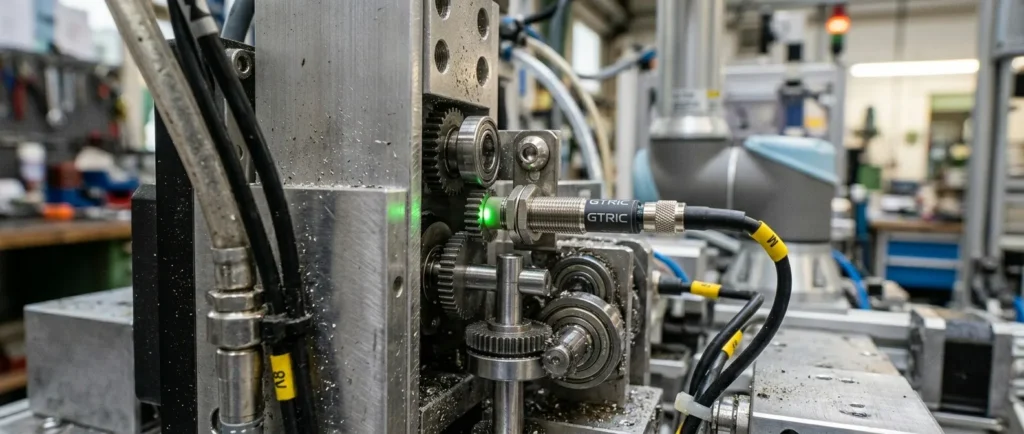
This guide will describe the core knowledge of the miniature inductive proximity sensors: what they are, how they work, which occasions they are suitable for, and why the Gtric miniature inductive proximity sensor series exists in the market.
Know Miniature Inductive Proximity Sensors
The working principle of miniature inductive proximity sensor is consistent with that of normal inductive proximity sensor. Unlike capacitive sensors, it has a natural immunity to dust, moisture and non-metallic interference, making them ideal for harsh industrial environments.
The classification of miniature usually refers to the sensor with a shell diameter between M3 and M6, and the diameter of some models is only 3 mm. Although they are very small in size, they provide the same performance as large-size inductive proximity sensors.
Why Choose Miniature Inductive Proximity Sensors?
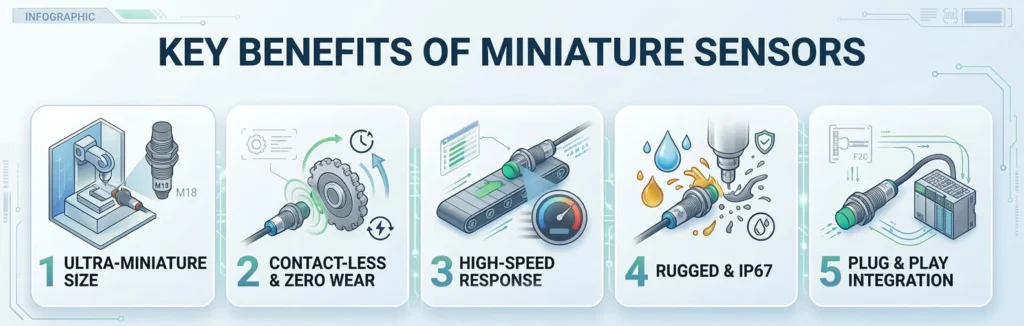
- Space-constrained installation occasions
The standard M12 or M18 sensors are too bulky to be used in miniature-assembly stations, small robot end-effectors or precision fixtures. Miniature inductive proximity sensors from M3 to M6 can be easily embedded in space that other sensors cannot reach.
- Non-contact, zero wear operation
Since the sensor does not need to physically contact the target, there is no mechanical wear, and the service life is far longer than the traditional mechanical limit switch.
- High-speed switching response
The miniature-inductance sensor supports switching frequencies up to 500 Hz, enabling counting and position feedback on high-speed production lines.
- Adapting to harsh working environment
With the Gtric miniature-inductive proximity sensor, the entire series of waterproof grades are IP67. Such sensors can work stably in coolant, cutting oil, metal debris, and vibration environments, and are very suitable for CNC and machining applications.
- Easy system integration
Most small proximity switches use integrated cables, and the output signals are compatible with micro controller platforms such as PLC and motion controllers.
Gtric Miniature Inductive Proximity Sensor Series
Gtric is focused on providing high-performance sensors for industrial automation. Their family of miniature inductive proximity sensors covers the M3 to M6 housing diameter range and is designed for precision OEM applications, robot integrators and automation builders.
| Full Specification Comparison: M3 / M4 / M5 / M6 | ||||
|---|---|---|---|---|
| Specification | M3 | M4 | M5 | M6 |
| Housing Diameter | 3 mm | 4 mm | 5 mm | 6 mm |
| Sensing Distance (Flush) | 0-0.9mm | 0-1mm | 0-1mm | 0-1.2mm |
| Sensing Distance (Non-Flush) | — | — | — | 0-2 mm |
| Supply Voltage | 10-30V DC | |||
| Output Type | NPN / PNP | |||
| Output Mode | NO / NC | |||
| Response Frequency | 500 HZ | |||
| Protection Rating | IP67 | |||
| Operating Temperature | -25°C ~ +70°C | |||
| Housing Material | Stainless Steel | |||
| Cable / Connector | 2m PVC Cable | 2m PVC Cable | 2m PVC Cable | 2m PVC Cable |
Notes:
- 1. The induction distance listed applies to the low carbon steel (Fe360) target. For stainless steel (x0.6-0.8), aluminum (x0.3-0.4) or brass (x0.5-0.6) targets, apply the corresponding reduction factor.
- 2. Non-flush installation is only suitable for the M6 model. The M3, M4 and M5 models only support flush mounting
- 3. All models support NPN and PNP outputs, and can choose normally open or normally closed contacts.
The entire M3-M6 series are standard with IP67 protection level.
| Recommended model of Gtric miniature proximity sensors | |
|---|---|
| Model | Best For |
| M3 | Precision instruments, miniature-robot finger sensing, medical device actuator feedback |
| M4 | Compact fixture positioning, semiconductor slot sensing, lab automation equipment |
| M5 | Component positioning, robotic finger detection, small press tooling, miniature-assembly fixtures |
| M6 | Conveyor part detection, PCB board positioning, CNC tool sensing, packaging machinery |
Flush Installation Vs. Non-flush Installation
When selecting a miniature inductive proximity sensor, one of the most common problems is to choose flush or non-flush installation method.
Flush-type
- It can be embedded in metal mounting brackets, flush with the surface of the bracket.
- The magnetic field is concentrated in front of the induction surface.
- The sensing distance is short, but the side interference resistance is stronger.
- Recommended for: metal panels, embedded tooling, narrow mounting channels
Non-flush Type
- The sensor must be protruding from the surrounding metal surface, the distance is not less than the diameter of the sensor.
- The induction magnetic field range is larger and the induction distance is longer.
- Suit for: open installation, conveying guide rail, bracket end.
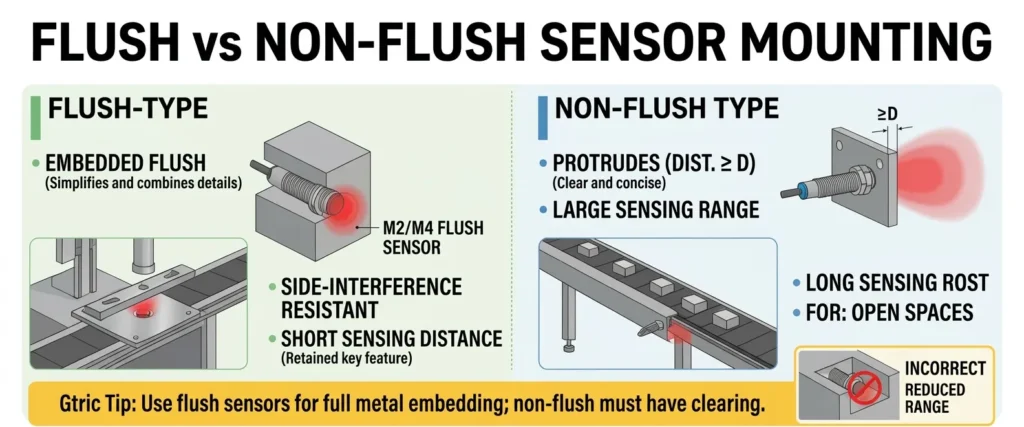
Gtric installation tips: When installing any M3 to M6 compact inductive sensors inside the metal support, be sure to use a flush mount. If a non-flush sensor is installed in the metal shell, its effective sensing distance will be significantly shortened.
How to Choose the Appropriate Miniature Inductive Proximity Sensors?
Step1: confirm the target material
The inductance sensor has different response characteristics to different metals. Please determine the reduction coefficient according to the corresponding material.
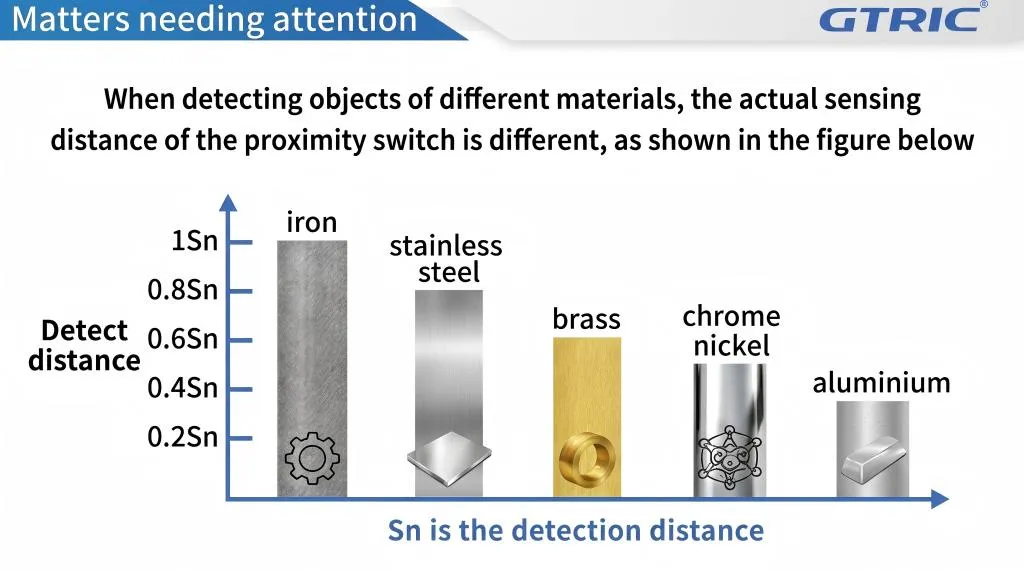
Step 2: determine the required sensing distance
The sensing distance of the Gtric miniature-sensor is usually 0.9 mm-2 mm, depending on the model specification (M3 / M4 / M5 / M6). Please measure the maximum gap between the sensor induction surface and the target in the static state to confirm the compatibility.
Step 3: select the output type
- NPN (Sink Output): PLCs and micro controllers common in Asia
- PNP (Source Output): Commonly found in North American and European automation systems
- Normally open (NO): Output activation when target is detected
- Normally closed (NC): The output is disconnected when the target is detected
Step 4: verify the level of protection
Cleaning, coolant or wet environment please choose IP67 or IP68 products.
Gtric M3, M4, M5, M6 inductance sensor series are equipped with IP67 protection.
Step 5: check the power supply voltage range
The operating voltage range of the Gtric miniature inductive proximity sensor is 10-30 V DC, but it is necessary to verify the output voltage of the control system, and some specific models may be different.
Application Scenarios of Miniature Inductive Proximity Sensors
Miniature inductive proximity sensors are widely used in many industries:
- Robots and Collaborative Robots: Detection of Clamping Finger Closure, Joint Limitation, and Tool Placement
- CNC machining: tool breakage detection, spindle origin positioning, tray recognition
- Electronic assembly: PCB tray detection, component insertion confirmation
- Medical Devices: Small Actuator Feedback in Surgical Robots or Laboratory Automation Equipment
- Packaging machinery: labeling machine indexing, bottle cap detection, heat sealing position positioning
- Semiconductor equipment: wafer box slot induction, miniature platform positioning
To learn more about technical standards and reference documents, it is recommended to access the following resources:
Gtric official miniature inductive proximity sensors manual
Can miniature inductive proximity sensor detect non-ferrous metals?
Yes, but there is a reduction factor. The standard sensor is calibrated based on ordinary carbon steel. Non-ferrous metal targets such as aluminum, copper, and stainless steel will shorten the effective sensing distance by 30-70 %. Be sure to consult the target material correction coefficient in the product data manual.
Can such sensors be used outdoors?
Yes, but need to choose IP67 or IP68 protection grade products. It should be noted that long-term ultraviolet irradiation will accelerate the aging of PVC cables. The type of PUR (polyurethane) sheath cable is recommended for outdoor or chemical contact environments.
How to choose Gtric M3, M5, M6 series?
The space is extremely limited, the target is very small, choose M3
Taking into account the volume and installation flexibility, choose M5 (the most common)
Need a little larger induction margin, installation space allows, select M6.
Summary
Choosing the right miniature-inductive proximity sensor is not only to find the smallest product, but also to accurately match the sensor’s sensing distance, target material suitability, output type and environmental protection requirements with practical applications.
Gtric covers the M3 to M6 specifications of the compact inductive sensor series, providing a reliable and cost-effective solution for technicians, designed to achieve stable metal detection in the most compact space. With IP67 stainless steel housing, wide voltage input range and NPN / PNP dual output options.
Explore Gtric’s complete sensor product line to find the best match for your next automation project.