




If your automated assembly line can’t accurately detect objects of different colors due to high reflectivity or changing background, resulting in sensor failure problems. Background suppression–BGS photoelectric sensor is the solution required for your production and operation. Traditional Ordinary diffuse reflection sensing technology often encounters the problem of false triggering when dealing with bright conveyor belts, strong light illumination or multi-color products. The background suppression technique completely eliminates these pain points, which rely on accurate distance measurements, not just light reflectivity.
This guide will detail the definition and working principle of BGS photoelectric sensors, their advantages over similar products, and how to correctly select and install them for your application scenarios.
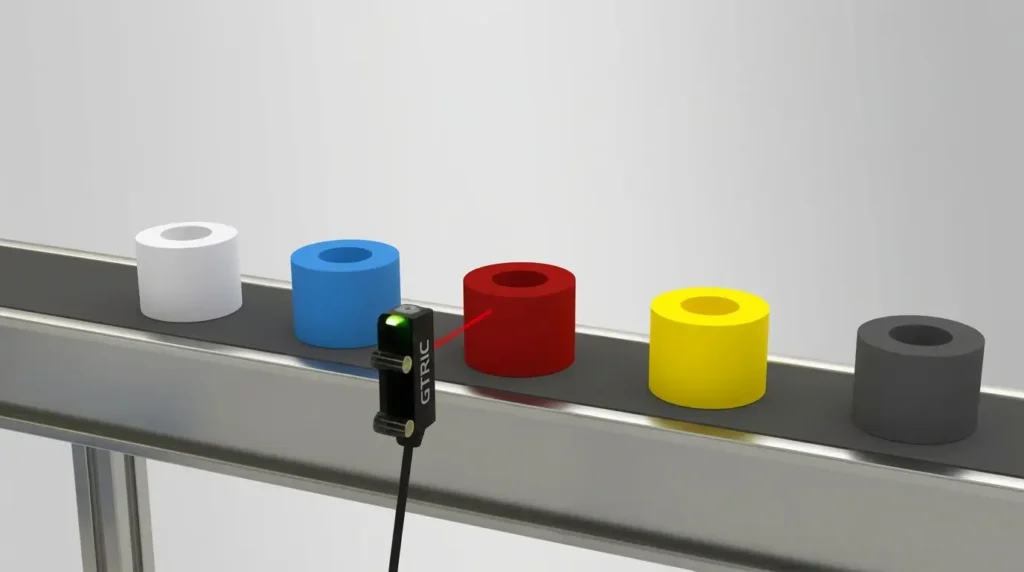
What Are BGS Photoelectric Sensors?
BGS photoelectric sensor is a special type of diffuse reflection photoelectric sensor, which is designed for accurate detection of target objects within a limited sensing range, while completely ignoring objects beyond this range. The detection distance is almost unaffected by the object’s color (the difference between black and white is very small), surface gloss, or background, and it has high repeatability and few false alarms.
The ordinary diffuse reflection sensor detects the target by the intensity of the returned light, while the BGS sensor detects the target by measuring the angle when the reflected light returns to the receiver. This angle triangulation method allows the sensor to establish a precise sensing cutoff point, thereby ensuring the suppression or ignoring of background reflected light beyond that distance (whether from a conveyor belt, machine panel, or warehouse wall).
What Is The Working Principle of BGS Photoelectric Sensors?
Before understanding the working principle of the BGS photoelectric sensor, you need to know the optical triangulation. In simple terms, it is based on the angle of return light.
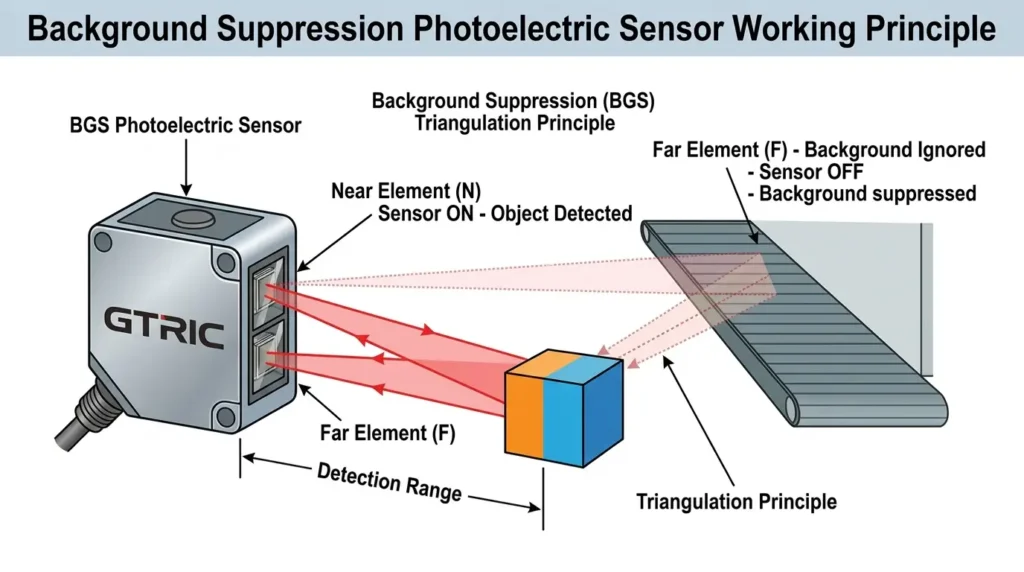
Here are the detailed working steps:
The BGS photoelectric sensor emits a focused beam to the target object (usually visible red LED or infrared light source). When the beam irradiates the target within the set sensing range, the light is reflected back to the dual-element receiver of the BGS photoelectric sensor at a specific angle.
Subsequently, the BGS photoelectric sensor determines the target position according to whether the reflected light falls on the near or far receiving element: if it falls on the near element, the output ON signal indicates that the target is detected; on the contrary, if it falls far away, the output OFF signal indicates that the target is out of range.
In this way, the reflected light of any background object beyond the set cut off distance will only trigger the remote component. Thus outputting the OFF signal and effectively suppressing the background interference.
| BGS Photoelectric Sensor vs. Standard Diffuse Sensor: Key Differences | ||
|---|---|---|
| Feature | BGS Photoelectric Sensor | Standard Diffuse Sensor |
| Detection Method | Triangulation (light angle) | Light intensity |
| Background Immunity | Yes | No |
| Color Independence | High | Limited |
| False Trigger Risk | Very Low | High (reflective surfaces) |
| Ideal Environment | Reflective or cluttered backgrounds | Clean, controlled backgrounds |
| Sensing Range Adjustment | Fixed or adjustable | Adjustable |
| Typical Housing Size | Compact to medium | Compact |
Whenever the detection accuracy near the reflective background becomes a key issue, the BGS photoelectric sensor has a decisive advantage over the traditional photoelectric proximity sensor.
5 Industrial Application of BGS Photoelectric Sensors
1. Packaging line target detection
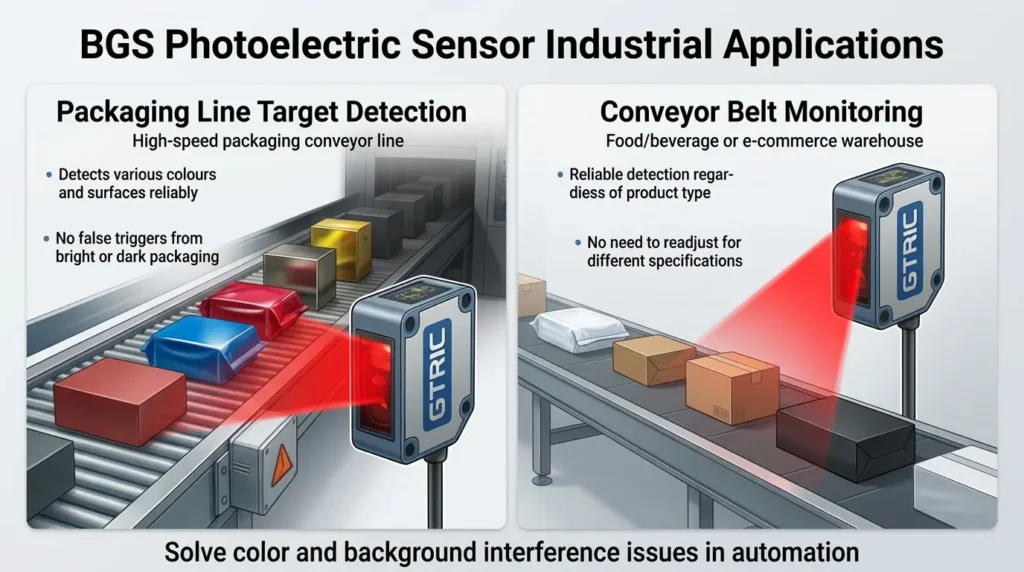
On the high-speed packaging line, it often covers a variety of colors, materials and surface treatments. From bright packaging to matte cardboard, there is a wide variety. Ordinary diffuse reflection sensors may be mistakenly triggered due to bright packaging, resulting in missed detection of dark products.
The BGS photoelectric sensor can accurately detect each target regardless of the surface reflectivity, and is widely used in:
- Validation of products before sealing or labeling
- Item counting on conveyor belt
2. Conveyor belt monitoring
With the conveyor belt as the background, the product is often placed directly on it. After installing the BGS photoelectric sensor, the product on the conveyor belt is detected without the need to reposition or adjust the sensor for different product specifications.
This makes it indispensable in the fields of food and beverage production, e-commerce warehousing performance center and auto parts handling.
3. Solar silicon wafer & electronic components detection
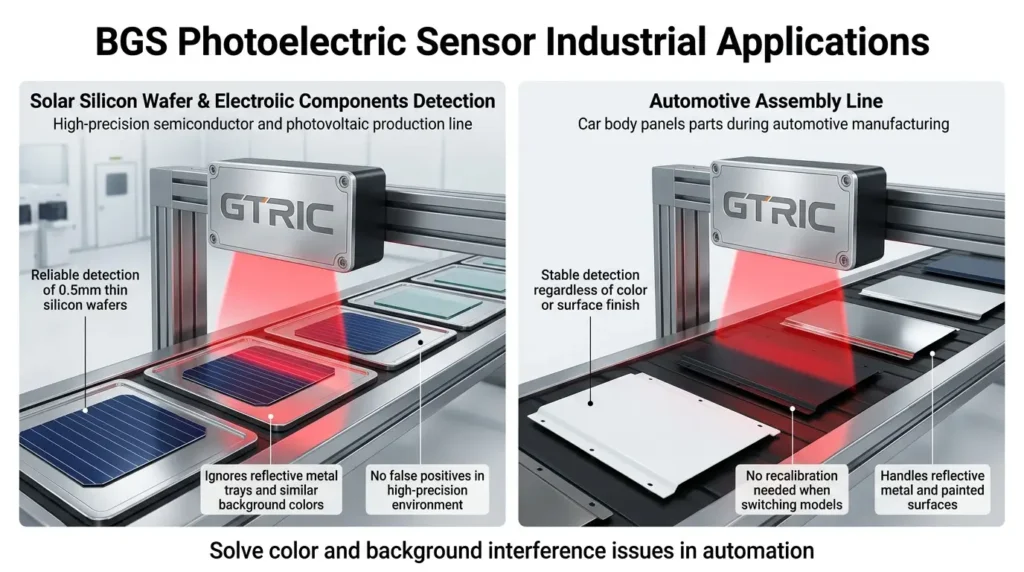
In semiconductor and photovoltaic manufacturing, the accuracy requirements are extremely high. The BGS photoelectric sensor can be used to detect micro silicon wafers and glass substrates on the production line. These background surfaces are often reflective or close to the target color. Its widespread use in this field means that it can reliably detect 0.5 mm thick silicon wafers on metal trays without false positives.
4. Automotive assembly line
Automobile manufacturing involves reflective metal plates, sprayed surfaces, and parts of dozens of color variants. BGS photoelectric sensors are widely used in this industry:
- Confirm the existence of the parts before the robot is taken and placed
- The edge position of the panel is detected to achieve alignment
- Trigger automatic welding or fastening
Since the BGS photoelectric sensor can be stably detected whether the target is bright white primer or dark matte paint, the production line doesn’t need to recalibrate the sensitivity when switching between different models, and can operate continuously and stably.
5. Logistics sorting and warehousing automation
In modern logistics facilities, the sorting machine needs to process thousands of packages per hour, spanning multiple transmission channels. BGS photoelectric sensors are often used in conjunction with barcode scanners and readers to detect the presence, height and location of packages.
Because of its strong resistance to ambient light interference and reflective background, it is suitable for application in large bright storage environments. In such environments, traditional photoelectric proximity sensors often produce a lot of misreading.
For an in-depth knowledge of Best 7 Photoelectric Sensor Types for Automatic Conveyor, the Gtric photoelectric sensor selection guide is an excellent technical reference.
How to Install and Debug BGS Photoelectric Sensor
To give full play to the performance of the BGS photoelectric sensor, please follow the following steps:
Step1: To determine the inductive geometric relationship.
The distance from the sensor installation point to the target is measured to ensure that the distance falls within the adjustable range of the sensor, and the background (conveyor belt, shelf, wall) should be clearly beyond the maximum cut-off distance of the sensor.
Step 2: Inclined installation
When detecting high reflectivity objects, the sensor is tilted about 5° relative to the vertical axis of the target. This prevents receiver saturation caused by direct specular reflection.
Step 3: Adjust the sensitivity from the background, not from the target
When adjusting the sensitivity potentiometer, the background falls outside the detection window, rather than the target falls within the detection window.
Step 4: Verify with dark and light color targets respectively.
Test the detection effect within the range of target color and surface type that may be encountered in the application. At a longer sensing distance, the color difference may cause an offset in the effective sensing distance–a sensor using an infrared light source can minimize this effect.
Step 5: Check the status indicator
The Gtric BGS sensor is equipped with a dual LED indicator: green power indicator and red induction indicator. Before use, the indication status of both should be in line with expectations.
Common Errors and Precautions
- The cut-off point setting is too close to the target: there will not be enough margin when the product changes or the sensor drifts for a long time.
- Ignoring the influence of ambient light: strong direct sunlight or high-intensity artificial lighting may cause sensor overload. Please select a model with high ambient light immunity certification.
- If the background distance is less than 3 times the target detection distance, the ordinary diffuse reflection sensor will cause a lot of problems.
- Ignore IP protection level requirements: Even in the context of clean use, cleaning agents and moisture can damage sensors with inadequate protection levels.
Why BGS Photoelectric Sensors Are Worth Investing In
When the detection accuracy, background suppression ability and stable operation time of the system are crucial, the BGS photoelectric sensor is always superior to the traditional alternatives. It is widely used in industrial automation toolboxes because of its working principle based on triangulation, color-independent detection performance and adjustable sensing range.
Whether you are optimizing the packaging production line, building a high-throughput logistics system, or ensuring precision electronics manufacturing, the correct selection and installation of Gtric BGS photoelectric sensors will effectively reduce false triggering, reduce maintenance costs, and comprehensively improve production reliability.