




What is a Fiber Optic Sensor Amplifier?
In the field of industrial automation and control, the fiber optic sensor amplifier is a core component of fiber optic sensors. It works in conjunction with the sensor probe to form the fundamental fiber optic sensing system.
To illustrate with an analogy: if we compare a fiber optic sensor to the human body, the sensor probe functions as the “fingers” (the sensing head). Electrically passive and highly robust, it can extend into harsh environments—such as high temperatures, strong electromagnetic interference, or confined spaces—to detect targets.
The optical fiber cable serves as the “nerve fibers,” connecting the periphery to the central processing unit. It rapidly and losslessly transmits optical signals from the sensing front, focusing solely on efficient, interference-resistant transmission without participating in decision-making.
The fiber optic sensor amplifier, in turn, acts as the “brain and eyes” of the system—the central hub. It emits light, processes and amplifies variations in the returned light intensity, performs judgment, and, when the light level meets the set threshold, outputs control signals to downstream devices such as PLCs to execute corresponding actions.
In industrial automation, fiber optic sensors serve as the most reliable “eyes” on the production line. Consider a scenario where a line produces 1,000 packages per minute: a tiny, barely visible label flashes past on the conveyor, yet the system responds precisely and accurately determines the cutting position within 0.025 milliseconds—this is the routine performance of fiber optic sensor amplifiers.
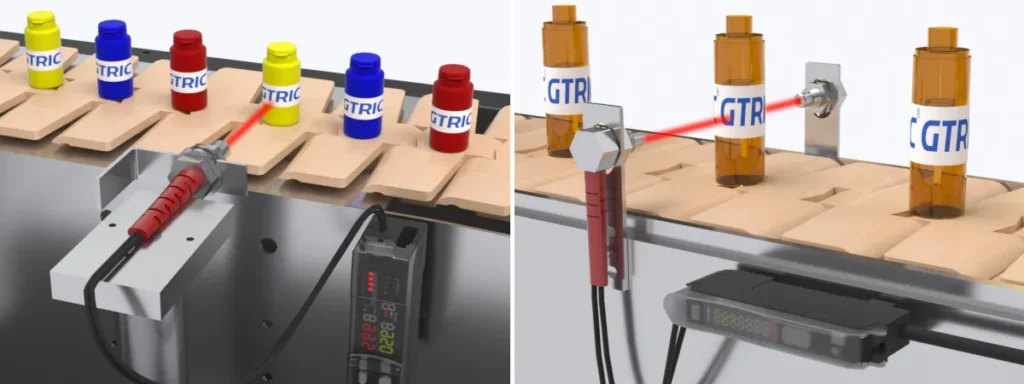
Working Principle of Fiber Optic Sensor Amplifiers
A optic fiber amplifier serves as the core processing unit in a fiber optic sensing system, handling the complete cycle of photoelectric conversion and signal conditioning. It integrates a light source (typically an LED or laser diode), a photodetector, and advanced signal processing circuitry.
The operation follows a precise, closed-loop process:
1. Light Emission: The amplifier’s internal light source generates modulated pulses of light at a specific wavelength. These pulses are coupled into the transmitter fiber and transmitted via total internal reflection along the fiber core to the probe tip, where the light is emitted.
2. Target Detection: Depending on the sensor type:
- Through-Beam Mode: Separate transmitter and receiver probes are positioned opposite each other. Light is interrupted when an object blocks the beam, reducing the received intensity.
- Diffuse-Reflective Mode: Transmitter and receiver fibers are housed in the same probe. Light reflects off the target surface and returns to the receiver, with intensity varying based on distance, surface reflectivity, or color.
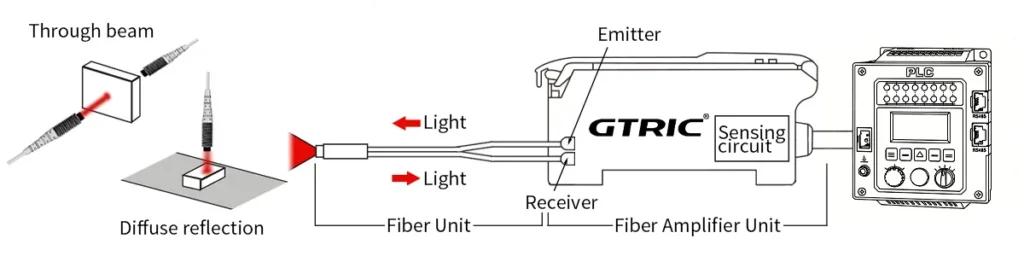
3. Signal Reception and Processing: The returned light travels back through the receiver fiber to the fiber optic sensor amplifier’s photodetector, where it is converted into an electrical signal. This signal undergoes amplification, noise filtering, and threshold comparison to eliminate environmental interference.
4. Output Generation: When the processed signal meets or crosses the user-set threshold, the optic fiber amplifier triggers an output—typically discrete switching (NPN/PNP transistor or relay) or, in advanced models, analog voltage (e.g., 0-5V)—to downstream devices like PLCs for control actions.
This cycle achieves response times in the microsecond range, with exceptional immunity to electromagnetic interference, making fiber optic amplifiers ideal for harsh industrial environments.
Key Advantages and Features of Fiber Optic Sensor Amplifiers
Building on the robust working principle outlined above, fiber optic sensor amplifiers stand out in industrial automation due to their superior performance in challenging environments. Compared to traditional photoelectric sensors, they offer distinct advantages that enhance reliability, precision, and system longevity.
Primary Advantages
- Immunity to Electromagnetic Interference (EMI) – Optical transmission eliminates electrical noise, making them ideal for environments with motors, inverters, or welding equipment.
- Operation in Harsh Conditions – Durable stainless steel probes withstand extreme temperatures (up to 300°C+ in some configurations), corrosive chemicals, high humidity, and intense vibration without performance degradation.
- High-Speed and Precise Detection – Microsecond response times enable accurate sensing on high-speed production lines (e.g., detecting objects at rates exceeding 1,000 per minute).
- Separated Design for Flexible Installation and Maintenance – The probe and optic fiber amplifier are designed separately: compact probes can be installed directly at the measurement point in hazardous or confined areas, while amplifiers are centrally located in control cabinets. This enables unified adjustment, monitoring, and troubleshooting, significantly reducing installation complexity and maintenance costs.
- Modular Design for Versatility – Any fiber optic sensor amplifier in the series can be paired with a wide variety of fiber optic probes and focusing lenses. This modular approach allows quick configuration changes to meet diverse detection requirements without replacing the entire system.
- Versatile Output Options – Support for discrete switching (NPN/PNP), analog signals (0-5V), and specialized functions like multi-color detection.
| Benifits and Features of Fiber Optic Sensor Amplifiers | ||
|---|---|---|
| Feature | Benefit | Typical Specifications |
| Response Time | Ultra-fast detection | 25/50/100/200µs |
| Probe Material | Enhanced durability | Stainless steel |
| Environmental Rating | Reliable in tough conditions | IP67, wide temperature range |
| Design Approach | Easy installation and customization | Separated probe/amplifier, modular |
| Output Types | Seamless integration | NPN/PNP, Analog 0-5V, Color detection |
At GTRIC, we fully embrace these strengths: our economical models deliver outstanding value for standard tasks, high-precision variants with digital displays excel in high-speed and vibration-prone lines, analog 0-5V output options enable precise continuous feedback, and our color detection amplifiers leverage RGB technology to distinguish up to 4 colors accurately—ideal for packaging and quality assurance.
Our GTRIC Fiber Optic Amplifier Lineup and Selection Guide
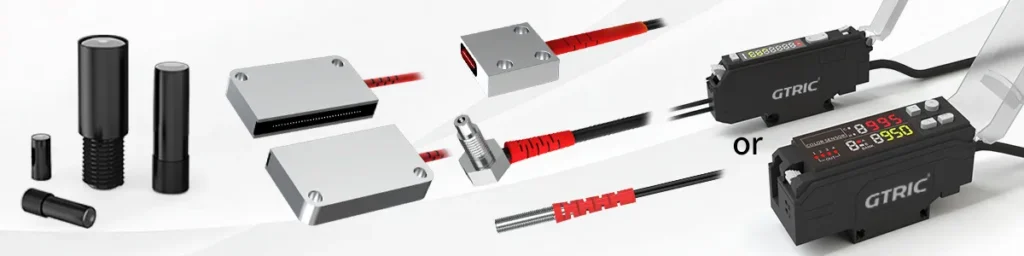
Leveraging the advantages and features outlined above—such as separated and modular design, robust stainless steel probes, and diverse output options—GTRIC offers a comprehensive lineup of high-reliability fiber optic sensor amplifiers. The GTRIC series is engineered for seamless integration, exceptional durability, and convenient customization, supporting hundreds of compatible fiber optic probes and focusing lenses to efficiently meet a wide range of industrial requirements.
1. Standard Switching Output Fiber optical Amplifiers (NPN/PNP)
- GTRIC Economical Models (EX-NA11 / EX-NA41 Series)
Key Features: Compact and user-friendly design with simple teaching functions and rapid installation for superior cost-effectiveness.
Applications: General object detection, counting, and positioning in standard production environments.
Pairing Recommendations: Combine with non-coaxial diffuse-reflective or through-beam fiber optic sensor probes for close-range detection, delivering an economical and straightforward setup.
- GTRIC High-Precision Models (EX-DN10 / EX-DP10 Series)
Key Features: Built-in LED digital display for intuitive parameter adjustment; ultra-fast response, extended detection range, and outstanding anti-interference and anti-vibration performance.
Applications: High-speed production lines and modern automation systems with stringent precision requirements.
Pairing Recommendations: For confined spaces or harsh environments, pair with high-temperature-resistant or narrow-beam focusing lenses; alternatively, use array-type fiber sensors for area-based detection.
2. GTRIC Analog Output Fiber optical Amplifiers (0-5V)
Built on the proven GTRIC high-precision EX-DN10/EX-DP10 platform, with added 0-5V continuous analog output in addition to standard NPN/PNP switching functions.
Key Features: Delivers proportional variable signal feedback to support advanced control requirements beyond simple on/off operation.
Applications: Precision positioning, distance sensing, or proportional control in robotics and assembly processes.
Pairing Recommendations: Pair with focused spot-detection or side-view probes for high-resolution distance measurement in confined spaces; alternatively, use array-type fiber sensors to determine object length based on occlusion level.
3. GTRIC Color Detection Fiber optical Amplifiers
Equipped with advanced RGB three-color light source technology for precise identification of subtle color variations, capable of distinguishing up to 4 colors simultaneously.
Key Features: Excellent tolerance to ambient light changes and high sensitivity to hue differences.
Applications: Color mark registration on packaging lines, print quality control, or stringent color consistency checks in the food, pharmaceutical, and printing industries.
Pairing Recommendations: Combine with coaxial reflective or high-resolution color-specific probes for optimal performance on fast-moving materials.
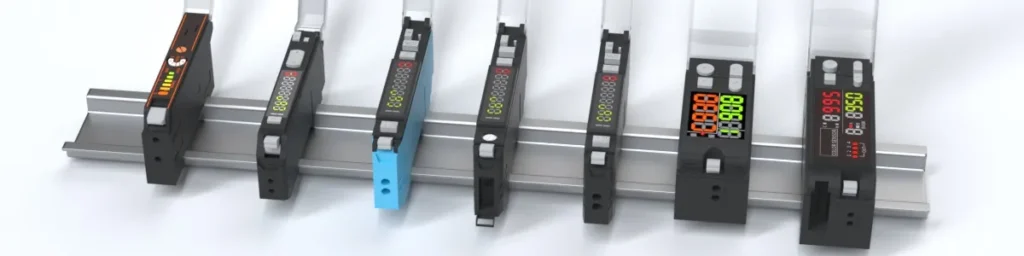
How to Select and Pair the Right GTRIC Amplifier
The modular architecture of the GTRIC series simplifies the selection process:
- Budget-Constrained Projects: Choose the EX-NA series for reliable and economical performance.
- High-Speed or High-Precision Requirements: Select EX-DN/DP models for demanding, vibration-prone environments.
- Continuous Signal Needs: Opt for GTRIC analog output models when precise proportional feedback is essential.
- Color-Sensitive Applications: Use GTRIC color detection models, tailored for packaging and quality assurance.
- Harsh Environments: The entire GTRIC lineup supports stainless steel probes with separated design; probes can be further equipped with armoring for enhanced stability in high-temperature or complex conditions.
Thanks to GTRIC’s fully modular architecture, any amplifier can be rapidly paired with the ideal probe or lens without requiring extensive system modifications.
Interested in experiencing the reliability of GTRIC firsthand? Contact our technical team for personalized selection guidance, detailed specifications, product catalogs, or sample evaluation.
Real-World Applications and Case Studies of GTRIC Fiber Optic Sensor Amplifiers
The modular design, robust performance, and versatile outputs of the GTRIC series enable reliable solutions across diverse industries. Below are real-world examples illustrating how GTRIC amplifiers address common challenges and deliver measurable improvements.
Case 1: High-Speed Packaging Line – Economical and High-Precision Models
A leading food packaging manufacturer faced frequent false triggers on a high-speed bottling line running at over 1,000 units per minute, due to vibration and ambient light interference from traditional sensors.
GTRIC Solution: Deployed EX-NA41 economical amplifiers paired with through-beam probes for basic counting, upgraded to EX-DP10 high-precision models with array-type fiber sensors for area detection in critical zones. The separated design allowed probes in harsh areas and amplifiers in a central cabinet.
Results: Reduced downtime by 30%, improved detection accuracy to 99.9%, and achieved faster response with minimal maintenance.

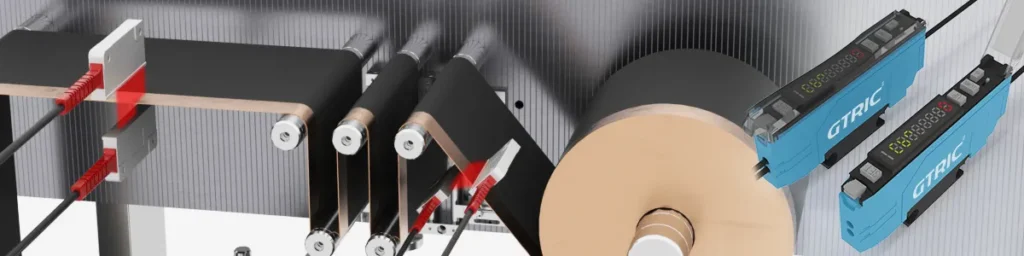
Case 2: Web Material Processing – Analog Output Amplifiers for Edge Guiding
A printing and converting facility experienced frequent web wandering and misalignment on a high-speed roll-to-roll production line, resulting in material waste, print defects, and reduced yield, as discrete sensors could only provide binary signals without proportional position feedback.
GTRIC Solution: Implemented the EX-DP10-MN analog output amplifier paired with array-type through-beam fiber optic sensors positioned across the web edge. The multi-beam array detected gradual edge position changes, converting them into continuous 0-5V proportional voltage signals for real-time feedback to the edge guiding control system.
Results: Achieved edge position control accuracy within ±0.5mm, reduced material waste by 25-35%, and improved overall line stability and throughput in dusty, high-speed environments.
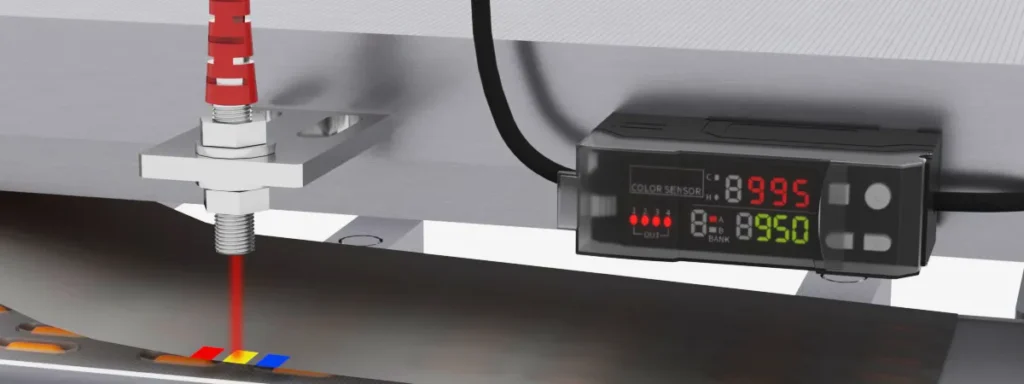
Case 3: Printing and Packaging Quality Control – Color Detection Amplifiers
A pharmaceutical packaging facility struggled with color mark registration errors on fast-moving webs, leading to misalignment and waste, as ambient lighting affected conventional sensors.
GTRIC Solution: Implemented GTRIC color detection amplifiers with RGB technology and coaxial reflective probes, capable of distinguishing up to 4 subtle color variations reliably.
Results: Achieved 100% accurate mark detection, eliminated misalignment issues, and increased line efficiency by 15%—critical for compliance in regulated environments.
These cases demonstrate how the GTRIC series—through its modular compatibility, durable.
Have questions about implementation or specific applications? Our FAQ section addresses common inquiries, or contact us for tailored advice.
Frequently Asked Questions (FAQ)
Have questions about implementation or specific applications? Our FAQ section addresses common inquiries, or contact us for tailored advice.
What sets GTRIC amplifiers apart from traditional photoelectric sensors?
GTRIC’s separated design allows flexible probe placement in harsh environments (high temperature, EMI, confined spaces) while keeping the amplifier protected. This offers superior durability and installation versatility compared to integrated traditional sensors.
How do I choose the right GTRIC model?
Consider your priorities: EX-NA series for cost-effective general tasks, EX-DN/DP for high-speed/precision, analog 0-5V for continuous feedback, or color detection for packaging applications. Our detailed product selection catalog (available for download on the website) includes specifications and recommended pairings to guide your decision.
How easy is installation and setup?
Installation is straightforward: Mount the probe, connect the fiber cable, and use one-button or automatic teaching for threshold setting. Digital models feature intuitive menus. We provide comprehensive manuals and step-by-step instructional videos for self-guided setup.
Can GTRIC analog models measure distance?
Yes—the 0-5V output delivers proportional signals based on light intensity, suitable for precise positioning or length detection (e.g., with array probes for occlusion-based measurement).
How reliable are GTRIC color detection amplifiers in varying light?
RGB three-color technology provides excellent ambient light compensation, reliably distinguishing up to 4 colors—even on fast-moving materials in packaging lines.
What maintenance do GTRIC systems require?
Very little: Periodically clean probe lenses and inspect connections. Stainless steel probes (with optional armoring) ensure long-term stability in tough conditions, with no electrical components at the sensing end.
Are GTRIC amplifiers compatible with major PLC brands?
Yes—they support standard NPN/PNP outputs for seamless integration with Siemens, Allen-Bradley, Omron, and other PLCs.
For any additional questions or personalized support, our technical team is here to help—just reach out!
In the era of rapid advancement in industrial automation and intelligent manufacturing, production lines demand increasingly stringent detection capabilities. GTRIC fiber optic sensor amplifiers are continuously evolving, with ongoing enhancements in sensitivity, accuracy, environmental adaptability, compactness, and intelligence. We are committed to delivering reliable, high-performance solutions that elevate your production efficiency and competitiveness.